
Articles
LATEST RESEARCH AND ARTICLES
FEATURED
MOST READ


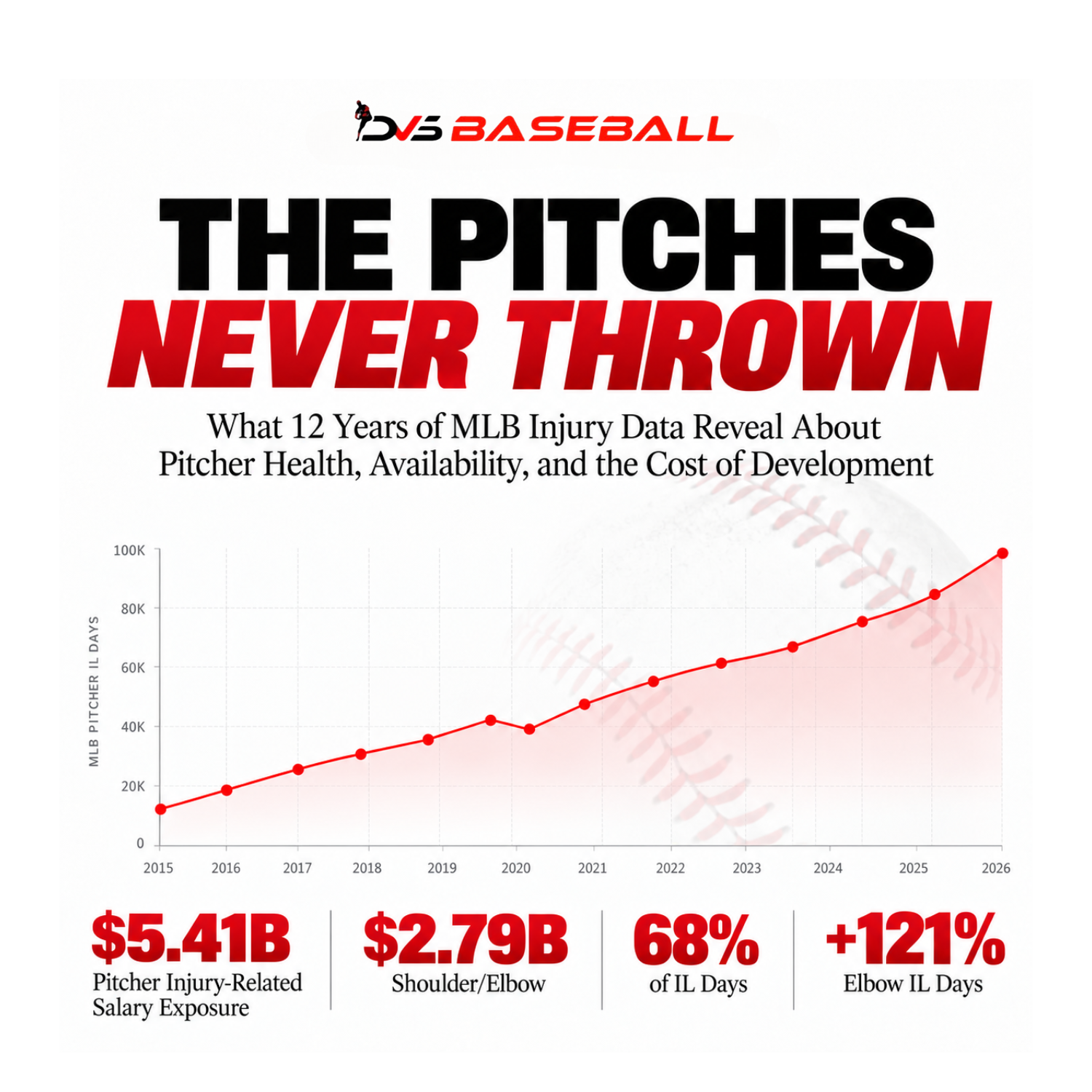
The Pitches Never Thrown
Baseball has never known more about the pitches thrown. But what about the pitches never thrown? DVS Baseball's analysis of 12 seasons of MLB injury data reveals $5.41 billion in pitcher injury-related salary exposure, a 121% increase in elbow-related injured-list days, and a critical question: Are we developing pitchers for greater performance, or the ability to sustain it?

When the Game Begins to Serve the Information
Because something can be measured does not mean it should become the measure of everything. Baseball’s danger did not begin when it acquired better information. It began when information ceased to serve the game—and the game began to serve the information.

Hunter Greene’s Second Elbow Surgery — And the Mechanical Window Many Pitchers Miss
Cincinnati Reds ace Hunter Greene is set to undergo his second elbow surgery since entering professional baseball. After analyzing more than 4,000 MLB pitchers, this pattern has become increasingly familiar. In today’s game, elite velocity alone is not enough to sustain a career. There is a subtle mechanical window in the pitching delivery—often missed—that determines whether a pitcher’s body can support high velocity over time. Hunter Greene’s situation highlights a sequencing issue many pitchers face, and why correcting it could be the difference between short bursts of dominance and a durable career.

Using LiveArm and DVS X-Ray to Guide High-Intensity Throwing
Returning to high-intensity throwing requires more than just increasing effort. In this article, I share how I’m using LiveArm strength testing and DVS X-Ray biomechanical analysis to guide my throwing progression, monitor shoulder strength, and ensure my mechanics remain efficient as intensity increases.

Talent Opens Doors. Durability Keeps Them Open.
If you’re labeled a top pitching prospect, you already checked the first box, you have the “stuff.” The next question is the one that determines careers: can you sustain innings and results long enough to earn the second, third, and fourth contracts? After watching Rhett Lowder return this spring, and seeing Chase Burns show the same modern “finish” trend, I want to make one thing clear, talent gets you noticed, but durability is what keeps the door open.

How can we use DVS X-Ray to improve a pitcher’s command?
Better command starts before the ball ever leaves the hand. When the body and arm are on time, the margin of error at release shrinks, and True Ball Flight becomes repeatable. In this article, I break down a detailed, real-world example of how we use DVS X-Ray metrics, then apply the M.V.P. Program to improve timing, sequencing, and command.

Using DVS X-Ray to Guide Conversations About Velocity Gains
If you’re responsible for developing pitchers, this is a practical guide to applying DVS X-Ray data in real time. I explain how DVS Score (energy creation) and Arm Impulse (energy transfer) work together, then walk through three pitcher profiles to show how to adjust training focus, ramp workload appropriately, and pursue velocity gains with better leverage and lower risk.

Improve Your DVS Score: The 4-Phase Blueprint for Healthy Velocity
A pitcher’s delivery isn’t just “mechanics”—it’s an energy system. The DVS Score shows how efficiently you’re using it, and the process in this article explains exactly how to improve it.

Sandy Koufax Was Right: The Foundational Truths Pitching Can’t Afford to Lose
Sandy Koufax’s timeless advice—“The biggest thing about control is controlling your body”—offers a blueprint for repeatable command, sustainable velocity, and healthier pitching. Explore how modern data can validate these foundational truths without replacing them.

Nearly Half of MLB Pitching Coaches Never Played Pro Baseball—Here’s What the 2026 Data Shows
A role-by-role look at 2026 MLB pitching staffs shows how many coaches have zero pro playing experience—and what that shift could mean for pitcher durability.

What 4,500 Youth Pitchers Reveal About Injury Risk Mechanics
We’ve added 4,500 youth pitchers to our DVS X-Ray database in the last six months—and the same mechanics pattern shows up from Little League to MLB. In our dataset, about 45% of pitchers fall at a DVS Score of 12 or below, the range our model flags as higher risk. That doesn’t guarantee injury, but it does signal that as velocity and volume rise, movement quality matters more—not less.

Velocity Is Easy to Measure. Sustainability Isn’t.
Velocity is trending up across baseball, but durability is trending the other way. The radar gun gives you the output—it doesn’t explain how the force was generated or whether it’s repeatable. By pairing the DVS Score with Arm Impulse metrics, pitchers and coaches can stop chasing peak numbers and start building sustainable velocity that holds up over a season and a career.

The $700 Million Arm, Not Who You Think
Gaylord Perry’s greatest advantage wasn’t a pitch. It was availability. In an era where dependable innings have become scarce, Perry’s career workload and value read like a modern market outlier. This article translates his durability into today’s economy and makes the case that he would have been priced as a $700 million arm.

The Durability Cliff: Why MLB Needs 42.7% More Pitchers
MLB teams are using 42.7% more pitchers per season since 2013—not because it’s smarter, but because durability is collapsing. With Days Lost to the IL up 71% and hundreds of millions paid to unavailable arms, the sport now rewards “stuff” faster than it rewards consistency. This is the Durability Cliff—and why the next advantage will be rebuilding traditional starter durability.

The Extinction of the Workhorse: A Data-Driven Look at the Decline of Starting Pitching
After analyzing over 1,100 elite pitchers drafted since 2013, the data reveals a sobering reality: a 38% injury rate and an "inning threshold" that is ending careers before they reach their prime. DVS Baseball founder Justin Orenduff breaks down the case study that explains why the 200-inning workhorse is becoming extinct and how we can engineer a path back to durability.

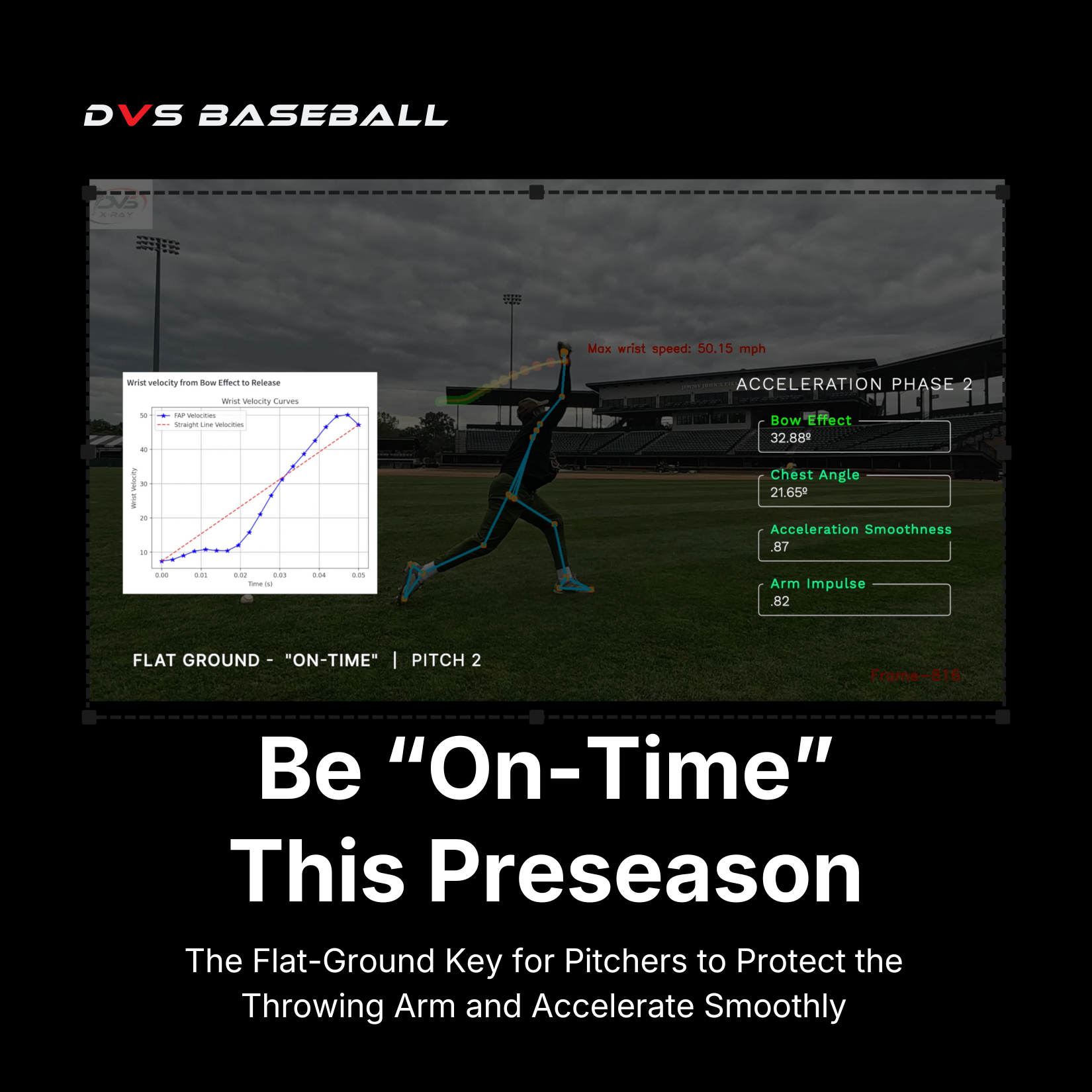
Be On-Time This Preseason: The Flat-Ground Key for Pitchers to Protect the Throwing Arm and Accelerate Smoothly
Preseason isn’t just about getting your arm in shape—it’s about getting your arm on time. When your forearm and spine are within 10° of parallel at foot strike, the arm can accelerate on a smoother, more efficient path (Acceleration Smoothness trending closer to 1.00). This article breaks down the flat-ground sequence that starts at the rear foot, improves Mass & Momentum, and helps pitchers protect the throwing arm while sustaining repeatable execution all season.

The $100 Million Starting Pitcher Blueprint
The path to a $100 million career doesn’t have to be a gamble on max-velocity—it’s a journey built on craft and consistency. Using Ranger Suárez’s recent 5-year, $130M deal as the gold standard, we explore how mastering the art of "taking the ball" creates the ultimate leverage. This article breaks down the three pillars of a high-value MLB career—Availability, Pitchability, and Sustainability—and shows why the most rewarding skill in baseball is the one that keeps you on the mound.

DVS X-Ray 5.0 Is Here: Redefining How We Measure the Fastball
DVS Baseball announces the release of DVS X-Ray 5.0, featuring Arm Impulse Metrics, improved scoring accuracy, and new Development Reports built on the medically published Delivery Value System.

Two Pitchers. Same Velocity. Which One Lasts?
Velocity alone doesn’t tell the full story. Two pitchers may throw the same mph, but the path they take to get there can mean the difference between health and breakdown. In this article, we explore how the DVS Arm Impulse Index reveals the efficiency, sequencing, and sustainability behind velocity—and how coaches and pitchers can use it to build lasting success on the mound.

22 Frames of Acceleration: Why How the Arm Accelerates Matters More Than Velocity
Velocity isn’t the full story. A 22-frame acceleration path reveals how pitchers build speed, protect arms, and sustain long-term performance.
After analyzing over 1,100 elite pitchers drafted since 2013, the data reveals a sobering reality: a 38% injury rate and an "inning threshold" that is ending careers before they reach their prime. DVS Baseball founder Justin Orenduff breaks down the case study that explains why the 200-inning workhorse is becoming extinct and how we can engineer a path back to durability.