Nearly Half of MLB Pitching Coaches Never Played Pro Baseball—Here’s What the 2026 Data Shows
Over the last few weeks, I put together a small study of pitching staff profiles across all 30 Major League Baseball organizations for the 2026 season. The question was simple:
How much pro playing experience do today’s pitching coaches have—and how does that change by role?
I grouped roles into six buckets—MLB, AAA, AA, A, assistants, and the increasingly influential director/coordinator lane—and tracked three basics: age, MiLB seasons played, and MLB seasons played.
I also added one flag that quickly reveals a structural shift happening across the sport:
Zero pro playing experience (0 MiLB seasons + 0 MLB seasons).
What the data showed wasn’t “right vs. wrong.” It was a clear sign of where modern pitching leadership is trending—and where the sport is quietly asking its biggest development question.
The shift: Leadership is increasingly built on systems, not playing résumés
The most striking pattern wasn’t at the bottom of the ladder. It was at the top.
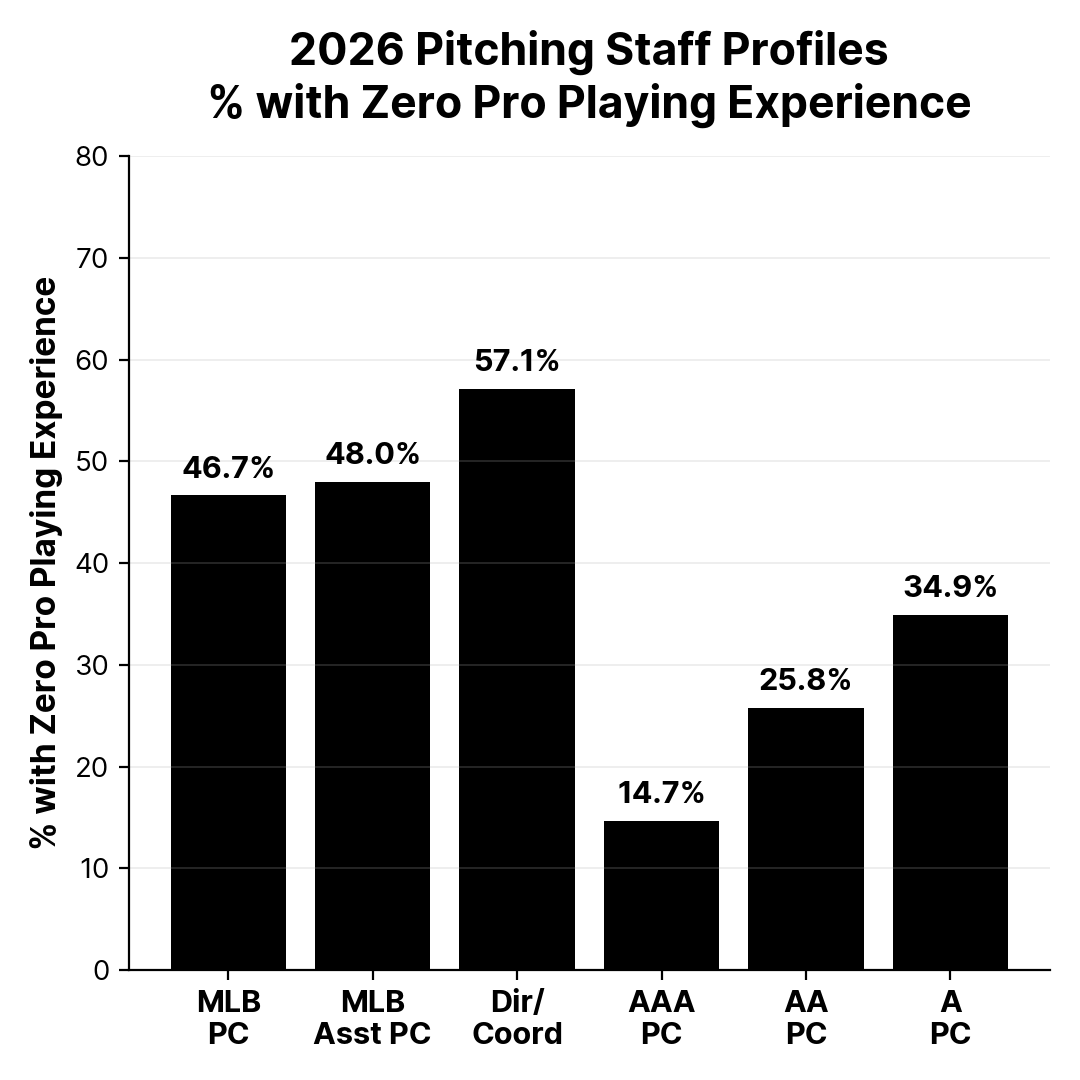
In this dataset, Director/Coordinator roles had the highest rate of zero pro playing experience—57%. MLB Assistant Pitching Coaches followed closely, sitting at nearly 50%.
In other words, the two lanes most connected to modern development infrastructure—planning, modeling, coordinating, standardizing—are increasingly being filled by people whose credibility isn’t rooted in playing time.
It’s rooted in something else: systems.
Not long ago, the sport’s pitching authority was often assumed. It was carried by big-league innings, years in pro clubhouses, and the language of experience. In 2026, the data suggests MLB is expanding the definition of what “qualified” looks like—especially in leadership.
The number that jumps off the page
The most attention-grabbing figure from the study is this:
46.7% of MLB Pitching Coaches (14 of 30) never played professional baseball.
That’s not a rounding error. That’s nearly half the league.
For a role historically associated with former pros—particularly former pitchers—MLB pitching coach has become one of the clearest examples of baseball’s broader evolution: more information, more specialization, more structure, and more coaching pathways that don’t require a playing career as an entry ticket.
AAA still looks like baseball’s “traditional” profile
If there’s one level that still resembles the classic coaching archetype, it’s AAA.
In the dataset, AAA pitching coaches were the oldest group on average and had the highest percentage of professional playing experience. If MLB is trending toward system leadership, AAA remains the point where organizations still appear to value traditional experience—often because the job demands it.
AAA isn’t just “development.” It’s the intersection of:
MLB-ready decision-making
big-league game planning
roster churn
and pitchers whose careers can change in a week
That environment tends to favor coaches who have lived the volatility—either directly, or close enough to understand it without guessing.
The 60+ leadership profile is nearly gone
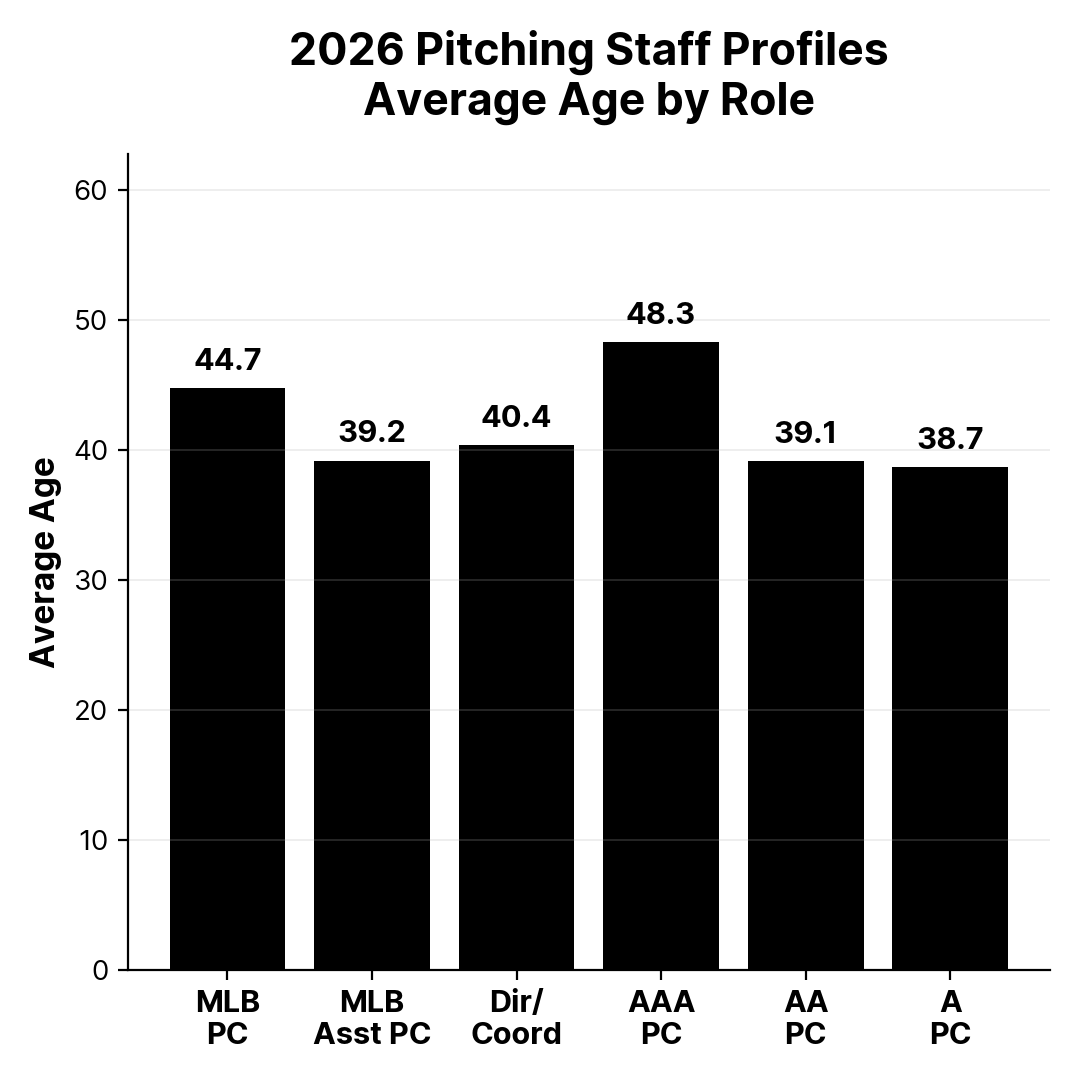
Another quiet but telling shift: the older veteran presence in leadership is fading.
In this dataset, only five people age 60+ were either MLB Pitching Coaches or Directors/Coordinators. That’s 2.2% of all roles analyzed, and just 6.3% of the leadership bucket.
The long-tenured, older former-player model—once common in dugouts and on back fields—has become increasingly rare in the roles that shape development philosophy.
And it raises a question worth asking out loud:
Why aren’t former MLB pitchers over 55 actively involved in coaching anymore—especially as the durability crisis grows?
Not as a ceremonial voice. Not as a token presence. But as a real, integrated part of the system.
Organizations are building in different directions
One of the most important takeaways isn’t league-wide. It’s team-to-team.
This dataset shows stark contrasts in how organizations structure pitching leadership:
Some still favor a more traditional playing-experience profile at multiple levels (e.g., Royals, Angels)
Others lean heavily toward staffers with zero pro playing experience (e.g., Orioles, Mets)
That contrast matters because it reflects two different operating beliefs:
Experience scales development (former players, feel-based instruction, pattern recognition through lived reps)
Systems scale development (models, language, standardized processes, coordination across levels)
In reality, the best organizations likely mix both. But the degree of mix—and the roles assigned to each lane—varies dramatically.
The question underneath all of it
This isn’t a debate about whether a coach needs to have played.
The game has changed. Development has changed. Coaching has changed.

But durability hasn’t gotten easier. It’s gotten harder—especially as velocity climbs.
So the real question isn’t whether the modern staff profile is “better.”
It’s this:
If velocity continues to rise and durability continues to fall… which staff profile is best equipped to build pitchers who can stay available?
That’s the development challenge of this era. Not throwing harder. Not designing better bullpens. Not polishing better pitch shapes.
Availability.
And the sport is still figuring out which leadership structure is best suited to protect it.
Method note
This is an as-listed snapshot of 2026 pitching staffs. Some teams staff multiple Director/Coordinator roles, so that bucket includes multiple people for some organizations. The coaching buckets (MLB/AAA/AA/A) were standardized using the single staff member labeled with a “1” for comparison.
Closing thought
Whatever the structure—traditional, modern, or hybrid—the goal should be the same: Do right by the players.
Because coaching isn’t about winning an argument. It’s about building pitchers who can:
develop
perform
and stay on the field long enough for any of it to matter
#pitching #leadership #business