In today’s MLB, “workhorse” has become a moving target. A 180-inning starter is treated like a pillar. Two hundred innings feels like a milestone. The sport still produces elite velocity and elite movement, but it produces fewer starting pitchers who can stay available, carry meaningful volume, and do it year after year without forcing an organization into constant contingency planning.
That is why Gaylord Perry belongs in a modern money conversation.
Perry threw 5,350.0 innings over 22 seasons, won 314 games, struck out 3,534 hitters, and finished with a 3.11 ERA. Baseball Reference credits him with 90.0 career WAR, which places his résumé among the most valuable pitching careers the game has recorded. His defining advantage wasn’t just performance. It was that he stayed on the mound long enough for his value to compound.
The durability isn’t a footnote. It’s the argument. Perry reached 200 innings in 17 different seasons (including 1966 through 1980), and he posted six 300 inning seasons (1969, 1970, and 1972–1975). Between 1967 and 1975, MLB notes he averaged 315 innings per season, a stretch of volume that now reads like a different sport. That repeatable workload is exactly what modern pitching staffs struggle to replace, and it’s the one thing the market keeps paying more for because it’s so scarce.
The predictable pushback is that the game has changed, so a pitcher like Perry wouldn’t be allowed to throw like that today. There’s truth in the premise, but it misses the economic point. Modern teams aren’t indifferent to innings. They manage workloads because breakdown risk is real, and because they rarely meet a pitcher who can carry the kind of volume Perry carried without falling apart. If a pitcher proved, in the modern environment, that he could sustain elite performance while absorbing elite workload, a front office wouldn’t just value his ERA. It would value the structural relief he provides to the entire roster.
To price that question in modern terms, you start with the same language teams increasingly use: value over time. A common shorthand in public valuation is to translate wins into dollars using the market’s approximate cost per win, and FanGraphs’ recent work has put that figure in the neighborhood of $8 million per projected win for starters and position players in this offseason. Apply that lens to Perry’s 90.0 WAR, and you land squarely in the low $700 millions before you even begin to talk about the premium teams would pay for durability in an era of constant pitching attrition.
That’s the foundation for the headline, and it’s why the clean conclusion is simple.
Gaylord Perry is a $700 million arm in today’s market.
Now comes the part that makes the number feel earned rather than theoretical. Perry’s case is not just a WAR story. It’s a durability story, and durability has a mechanical cause. At DVS, we don’t view availability as luck or toughness. We view it as an output of efficiency: the ability to move mass and leverage in a repeatable sequence so the throwing arm isn’t forced to solve the entire delivery under time pressure.
When you watch Perry, you see a pattern that matches what durable pitchers tend to share. He anchored into the back foot and used the ground as the start of the energy system. He kicked the lead leg up with rhythm, opened the pelvis to create space and timing, and brought the throwing arm up on time so the arm could ride the sequence instead of playing catch up. From there, he accelerated upper mass and the arm toward home plate and finished with full body commitment through release, often with the torso working down and through until the upper mass approached parallel with the ground. That finish isn’t a style choice. It’s a signal that mass is moving through the throw, which reduces how often the arm has to manufacture the outcome late.
This is the bridge between mechanics and money. A durable delivery doesn’t just protect the arm. It protects the roster. There is a hidden cost in the modern game that doesn’t show up in a box score. Call it the bullpen tax. Every inning a starter doesn’t provide has to be absorbed elsewhere, usually by a rotating cast of arms that are less predictable and more volatile. That creates churn, replacement innings, and constant stress on the staff over six months. Perry reduced that tax simply by staying out there.
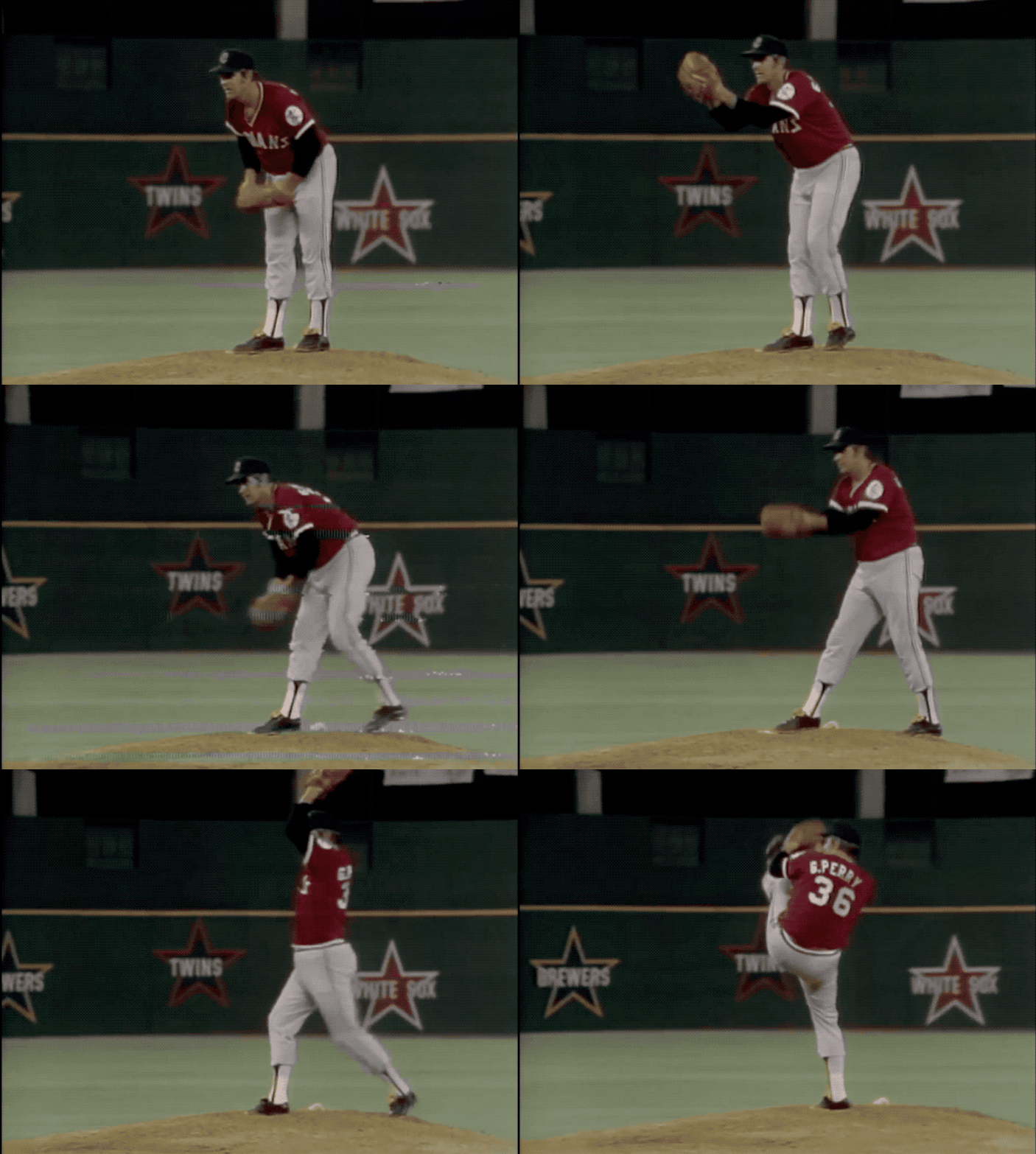
The cadence of movements as Gaylord Perry begins his windup helped fuel the pitching delivery that produced over 5000 MLB innings.
His 1972 season is a perfect illustration of what the market is really buying when it pays for certainty. The Hall of Fame’s recap of that stretch notes he posted a 1.92 ERA over 342.2 innings while logging a league high 29 complete games on the way to the Cy Young Award. Even if modern usage patterns reduced those innings totals, the point is the same: Perry’s value wasn’t just run prevention. It was the volume of certainty.
By a straightforward WAR based valuation, Perry’s career lands in the low $700 millions. The estimate isn’t meant to be perfect. It’s meant to show what the market would do with a pitcher who could stay available long enough for greatness to compound.
Here’s the concise money model that gets to the top number, framed the way baseball pays pitchers: entry years, arbitration, free agency, and then the deals that follow.
To sanity-check this against the modern market, start with what baseball already pays at the top end. The current system has a built-in cap early in a career, with the 2026 minimum salary set at $780,000 under the 2022–2026 CBA. The market then expresses itself most clearly in veteran pricing, and we know the league has already entered the $40M AAV era for elite pitching. Zack Wheeler’s Phillies extension carried a $42 million AAV, reported as the highest AAV for a contract extension in MLB history.
The only real leap in the Perry model is the idea that a uniquely durable ace would reset the top of the market because he provides more than ace-level run prevention. He provides roster efficiency. In that world, $52M AAV is not a gimmick number. It’s a premium placed on a pitcher who reduces the bullpen tax and lowers organizational risk in the one place modern teams can’t seem to control: keeping pitchers on the mound.
This is also where the conversation needs to stay respectful to the modern era. Pitchers today are asked to throw harder, with more movement, and in many cases with more max-effort intent than ever before. That makes durability even more valuable, not less. The modern game didn’t stop needing innings. It simply became less capable of producing them reliably.
From the DVS lens, the takeaway is not that baseball should chase 300-inning seasons because “that’s how it used to be.” The takeaway is that durability is increasingly the market inefficiency hiding in plain sight. If biomechanics can identify and develop deliveries that sustain output with less breakdown risk, the pitchers who can stay available will keep becoming more expensive. Gaylord Perry is the historical example that proves how large that number can get when availability becomes the rarest tool in the sport.