Velocity Is Easy to Measure. Sustainability Isn’t.
Velocity is trending up across baseball. Everybody can see that. The radar gun tells the story in one clean number, and the sport has built an entire incentive system around chasing it. But the radar gun only gives you the output. It doesn’t tell you what it cost the athlete to produce it, or whether that output is sustainable across a season, a career, or a development cycle.
Right now, the cost is no longer theoretical. It’s showing up in the one place the game can’t ignore: payroll. From 2015 to 2025 (excluding 2020), MLB pitching salary lost to the IL climbed from $330.8M to $641.1M, peaking at $696.3M in 2024. That isn’t bad luck. That’s a signal. The system is producing more velocity, and it’s also producing a growing volume of arms that can’t stay on the mound. If velocity keeps rising, context has to rise with it, because the real question isn’t “how hard do you throw?” It’s “how are you generating the force to throw that hard—and how long can you keep doing it?”
That’s where most conversations break down. We treat velocity like a standalone trait instead of an outcome created by a sequence of events. And when outcomes are rewarded more than processes, pitchers will find ways to reach the number—sometimes with patterns that look effective on a radar gun but are expensive at the elbow and shoulder.
Arm Impulse Metrics
At DVS, we frame this through a concept that’s simple to understand but rarely discussed in player development: arm impulse. Impulse is how far and how long you can apply force during the acceleration of the throwing arm. It’s not just peak speed. It’s the pathway to peak speed. It’s the difference between a delivery that builds velocity early and continuously, and one that stays quiet until late, then tries to catch up in a hurry.
When you look at a velocity profile over time, you can see what the radar gun hides. An “ideal” profile is a steady ramp—velocity building predictably until peak. In reality, many throwers show a curve that drifts early, then climbs aggressively late. Two pitchers can reach similar peak velocity and create entirely different load profiles to get there. One builds speed with a smooth, efficient ramp where the body contributes and the arm accelerates on time. Another spikes late, where the arm has to rush to catch up and create a sharper acceleration pathway to hit the same peak. That distinction matters because the body can support force generation. The elbow and shoulder can only survive it for so long.
This is where smoothness becomes part of the conversation. Smoothness is how efficiently and cleanly velocity ramps to peak without abrupt spikes. A smoother ramp generally indicates the system is sequencing and transferring energy more effectively. A spiky ramp often signals compensation—an arm doing more of the work in less time because the chain didn’t deliver enough energy early. None of this is anti-velocity. It’s pro-sustainability. If the game is going to continue pushing the ceiling of performance, we have to build better tools for protecting the floor: availability, durability, and repeatability.
That’s also why “average velocity is up” can’t be the end of the conversation. If we’re watching the league continue to climb—and we’re watching durability costs climb in parallel, then modern development has to stop treating velocity like a lottery ticket and start treating it like a skill that must be engineered responsibly. Otherwise, the market unintentionally selects for behaviors that create short-term gains and long-term breakdown risk. Players are rational. They respond to what gets rewarded. If peak numbers get rewarded, they’ll chase peak numbers. The problem is that the bill arrives later, often when the pitcher has already been replaced by the next arm in line.
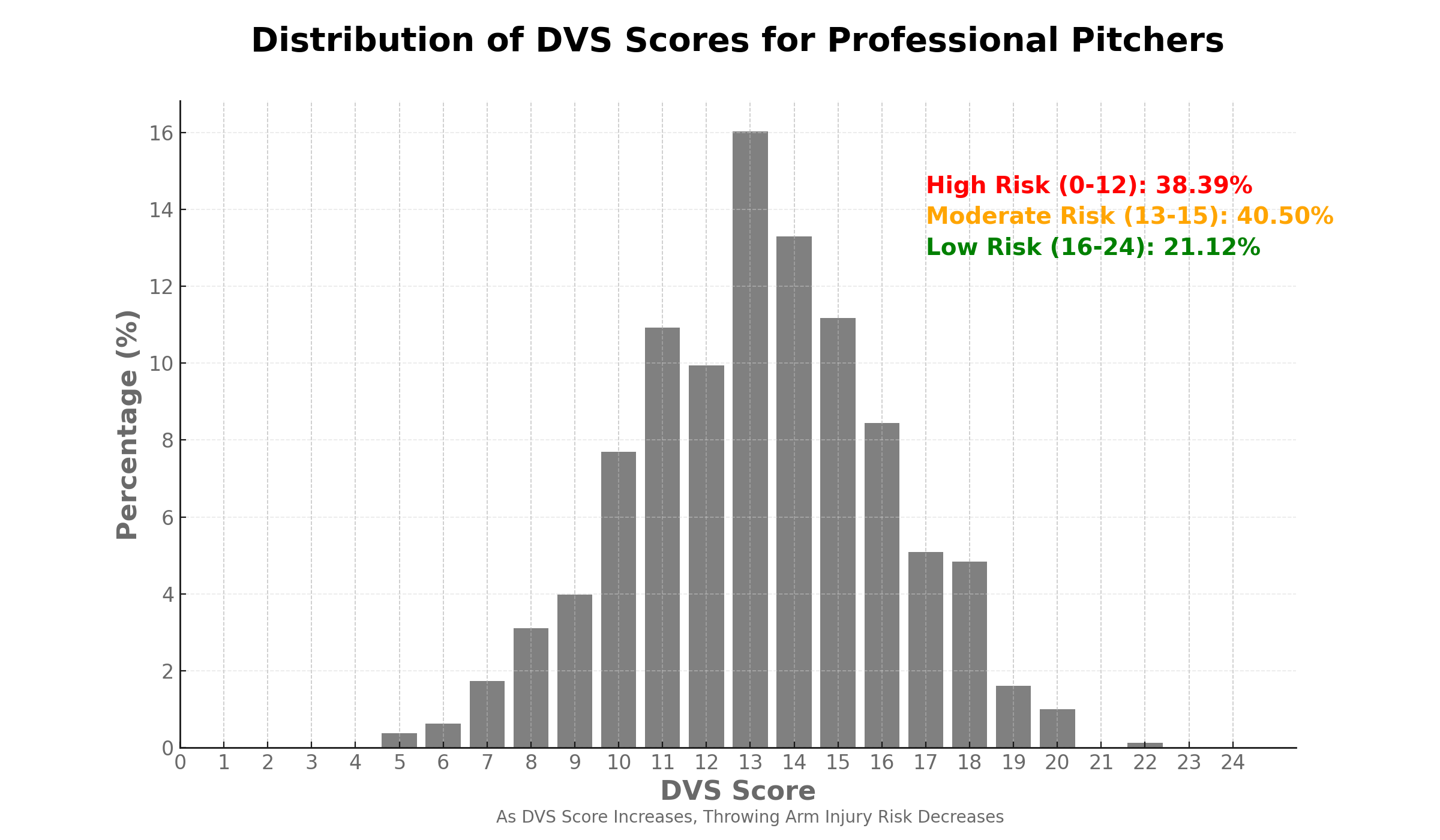
A majority of MLB Pitchers fall into the high risk category which aligns with if force increases (velocity), the joint integrity of the shoulder and elbow will diminish, leading to increased rates of injury.
This is exactly why DVS pairs two things that should always be connected but rarely are: the DVS Score and arm impulse metrics. The DVS Score tells you what your delivery is likely to demand from your arm, based on measurable movement patterns, timing checkpoints, and risk-linked mechanics. It gives you the “why” behind stress—where the chain is leaking, what patterns are forcing the arm to do too much, and what needs to be cleaned up if you want to stay available. Arm impulse metrics quantify how force is being applied during acceleration—how the arm builds speed, how long force is sustained, and how smooth that pathway is. One tells you what’s breaking the chain. The other tells you how the throw is being paid for.
Put together, they give the context modern pitching development needs. You’re no longer just chasing a number. You’re building a delivery that can generate force earlier, distribute it better, and let the arm accelerate the way a healthy arm is supposed to: smoothly. You’re building velocity you can actually keep. Because the future of pitching won’t just belong to the hardest throwers. It will belong to the throwers who can keep showing up, keep taking the ball, and keep producing without constantly borrowing from the arm.
Velocity matters. The radar gun just doesn’t show what it costs. DVS Score plus arm impulse metrics gives you the missing context—so performance gains don’t have to come with a hidden bill. If you want a clearer picture of your delivery and a plan built around sustainable gains, start with a DVS Score and pair it with arm impulse analysis inside DVS X-Ray.