How can we use DVS X-Ray to improve a pitcher’s command?
For more than a decade, I’ve used a refined process to help pitchers improve sequencing, timing, and the ability to execute a better throw, or a better pitch, more consistently. I refer to that outcome as True Ball Flight.
The methodology hasn’t changed. What has changed is our ability to measure it.
As DVS continues to evolve, DVS X-Ray now gives us the tools to quantify the movement patterns that drive command and the specific improvements that reduce a pitcher’s margin of error at release. As more of our clients adopt DVS X-Ray alongside the M.V.P. Program, I want to show a clear example of how we integrate both to help pitchers improve command.
Two environments, one goal
Throughout my coaching career, I’ve worn two different hats, both with the same objective.
First, I’ve trained pitchers of all ages and abilities inside a facility environment, and I rarely get to see them pitch in real games. Second, with the USPBL, I’ve been able to train pitchers while directly seeing how those changes translate inside a professional-season environment.
That combination has taught me something simple and important.
When we teach pitchers the foundations of the delivery as an energy system, a system that helps the body and arm get on time, all the time, we can directly influence consistency, throw to throw, pitch to pitch, across every application where the goal is execution.
As True Ball Flight improves in catch play, it improves in bullpens. As it improves in bullpens, it carries into games. This is the path pitchers walk as they develop.
Proof the process scales
A great example came in 2021.
In January, we began working with the coaches and pitchers of Taylor North Little League, outside Detroit, Michigan. Every Saturday, four to six pitchers traveled to our DVS Madison Heights location for ongoing training.
The development process over four months was the same one I’ll reference in this article. The goal was to build consistency and add more depth to their staff, not relying on only two or three arms, but four to six.
We never expected that a few months later, they’d go on to win the 2021 Little League World Series.

Click here to read the Article in the Detroit News about DVS and Taylor North Little League
“And what I like about them (DVS) is they put a ton of effort into understanding how to protect young arms as you progress in age, and they put more emphasis on throwing technique as opposed to building velocity. They really try to protect elbows and shoulders.
”We’ve worked with them a long time, and that (DVS) enhanced what we had.””
Why does it work?
At its core, command improves when we reduce the margin of error at ball release.
That reduction is driven by improved body and arm efficiency early in the delivery, but it also comes from something pitchers don’t hear enough, command improves when you build trust and let the delivery happen, instead of forcing it.
This is where the art of pitching lives. We’re not just creating better throwers, we’re developing pitchers who can repeat movement, stay on time, and execute under pressure.
As we progress through the article and introduce the DVS X-Ray metrics that influence command, I want to set the stage with the player example I’m using, and the specific metrics that relate most directly to execution.
Case Study, Bohdan P.
February 21, 2025, initial evaluation
I met Bohdan before his junior-year tryouts, when he came in for his initial DVS Score evaluation. He presented a unique case, his mechanical efficiency was relatively good, he had a history of minimal arm fatigue or injury, but he experienced periods of inconsistency in games that showed up as command variability.
Here is the video and metrics from that evaluation.
Initial metrics, Eval
DVS Score, 17
PAFS_VERT_DIFF_DEG, 52°
PAA_SPINE_DEG, 31°
PAA_RELEASE_DEG, 52°
PAA_EXTENSION_DEG, 5°
The metrics we use to support the command are as follows:
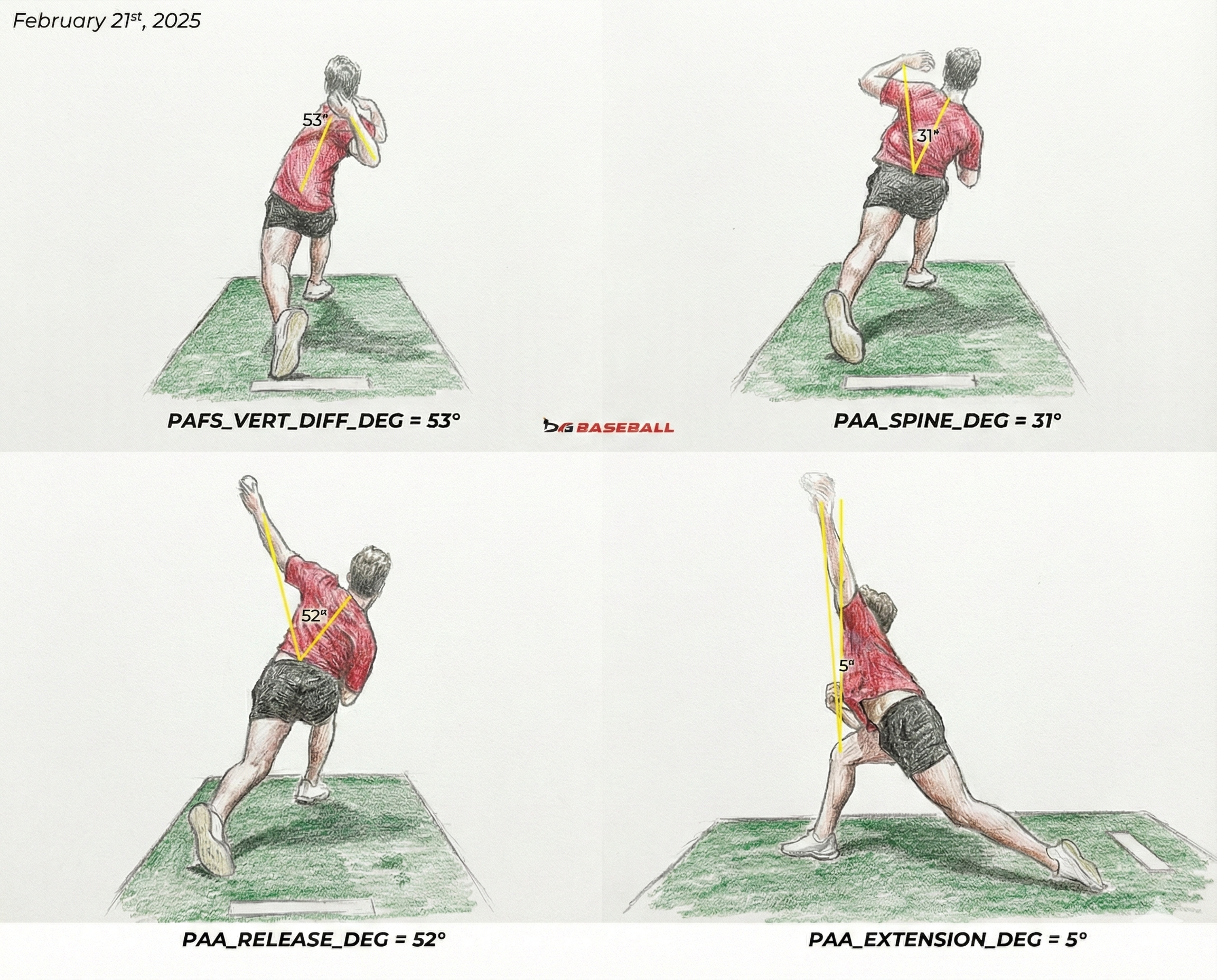
PAFS_VERT_DIFF_DEG
This metric measures the degree of difference between the throwing forearm and the spine at foot strike. It is one of our core timing metrics because it tells us whether the throwing arm is on time, allowing it to accelerate into release with better efficiency.
In our system, we label the throwing arm as on time when this metric is 10 degrees or less.
PAA_SPINE_DEG
This metric gives us context for how the trunk is organized through the delivery, and how well the body is setting up the arm to repeat direction and stabilize the throw.
PAA_RELEASE_DEG
At ball release, this metric indicates how closely the body stays together to support the throwing arm, and maintain its direction toward the target.
PAA_EXTENSION_DEG
This metric gives us insight into how far out in front of the body the baseball is released. The angle is measured from the front knee to the release angle. As the angle improves, pitchers often gain perceived velocity, better depth, and a more consistent ability to get the ball out front, which matters for command and quality of finish.
The bigger point here is that you should collect the metrics that match your development system, and establish baseline markers you can train against. I teach off ball flight, and I teach off the sequence that allows the body and arm to execute the intended outcome. As you get better at helping pitchers get on time, you start seeing the outputs of the pitch correlate more clearly.
The Development Plan
If we want to improve command, we first need to understand what’s preventing the pitcher from being on time.
In Bohdan’s case, he showed what we often call active arms, or the fly-fly-away pattern. In his initial video, his throwing arm extended away from his midline too early as he moved into the throw. Whether he realized it or not, his upper body and throwing arm were becoming the primary drivers of movement.
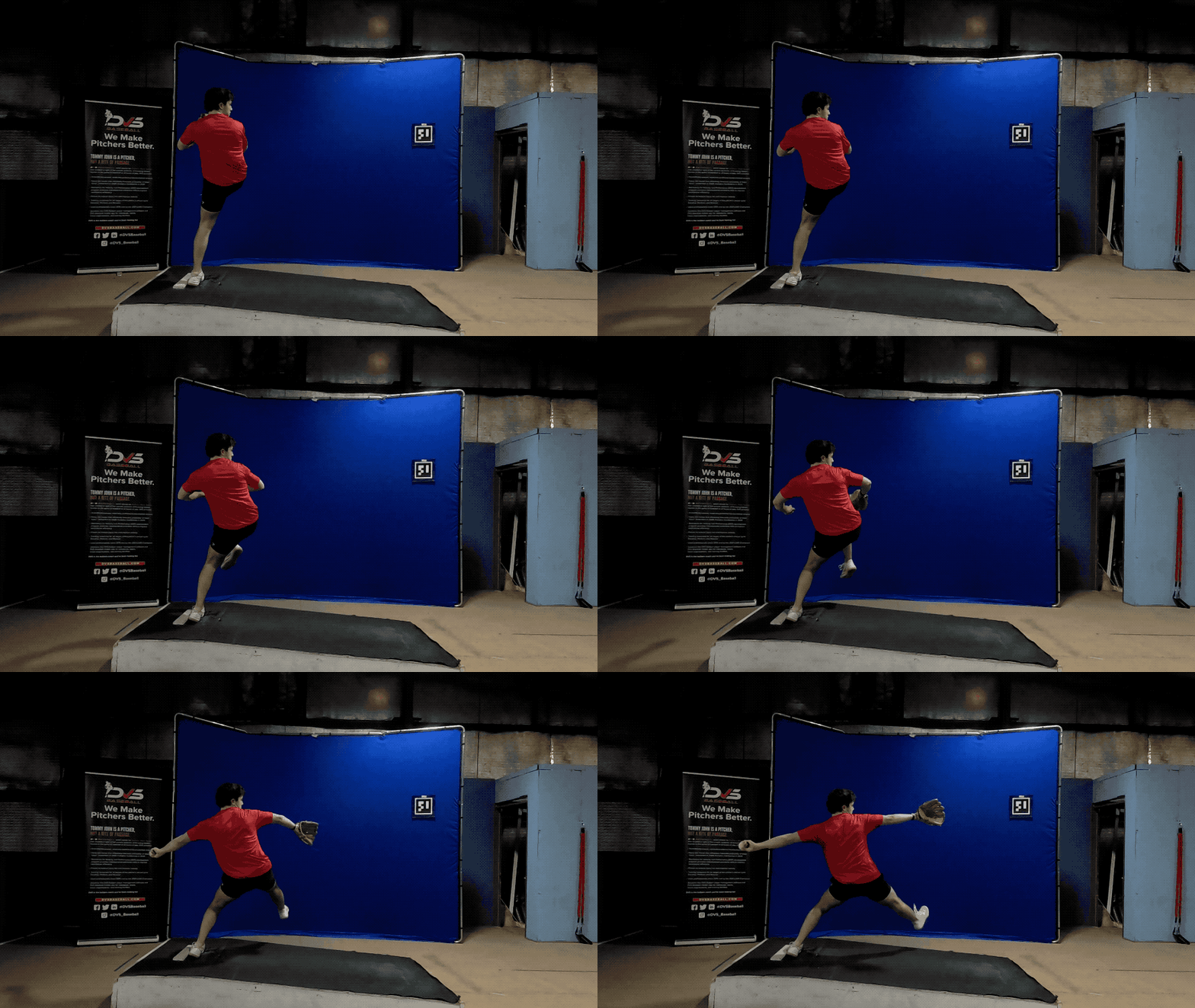
Bohdan P displaying “active arms” as the driver early in his delivery
That pattern tends to create two problems seen in the video below: prolonged shoulder retraction that delays the throwing arm from rotating into a throwing position sooner, and forward drift of the spine and upper body as the hips open, which often leads to overstriding and inconsistent release timing.
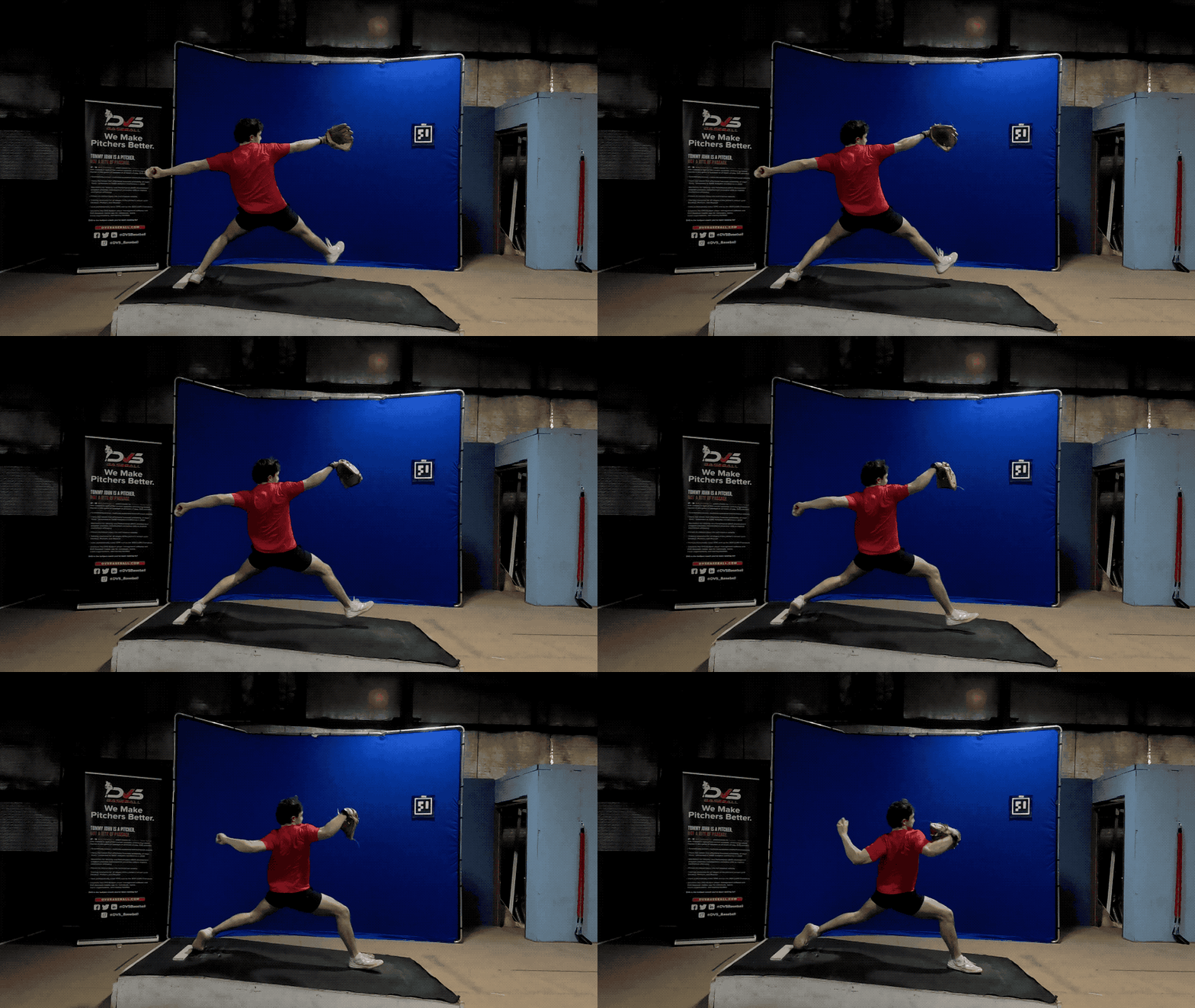
Bohdan is transitioning from the Gateway position to Foot Strike.
Our initial focus, short runway before the season
We didn’t have long before his high school season ramped up, so we kept the plan simple and targeted.
We taught Bohdan to let the back foot initiate forward movement, we trained him to keep his hands in the glove longer and trust the initial move, and we emphasized allowing the back-leg ankle to set and match the slope of the mound.
Inside the M.V.P. Library, this work ties directly to the Ankle Drive Progressions and the Roller Coaster drills.
We also spent significant time developing the feel of upper mass shifting, arms swaying back with rhythm, looseness through the spine, and a delivery that can move front to back without the arm trying to win the race early.
The goal was to create the Stretch Effect, a natural separation and sequence between lower body and upper body that helps the pelvis rotate the throwing arm up on time at the Gateway position, without extra movement that disrupts timing.
The Results
Less than two months later, you could already see a dramatic change in Bohdan’s delivery, especially his timing at foot strike, his ability to lower the chest at release, and his ability to create a better release angle, throw to throw.
As his season progressed, Bohdan pitched well enough to earn First Team All-Region honors, and help carry his team to the state playoffs. His outing-to-outing consistency improved, including multiple games with ten or more strikeouts. Most importantly for the basis of this article, his command became a separator.
That summer, Bohdan continued to progress, began throwing in the upper 80s, and earned a scholarship to pitch at Randolph–Macon College.
February 21, 2026, one year later
Fast forward a year, and Bohdan is now demonstrating one of the most consistent deliveries I’ve seen in a young amateur pitcher.
From catch play to bullpens, the maturity in how he aligns his body and repeats his delivery is top notch. The original goal, True Ball Flight, is consistently on full display.
Here are his most recent metrics and video.
DVS Score, 19
PAFS_VERT_DIFF_DEG, 10°
PAA_SPINE_DEG, 23°
PAA_RELEASE_DEG, 43°
PAA_EXTENSION_DEG, 11°
The Difference
At the end of the day, I’m only half the equation; Bohdan is the other half.
He invested time, focus, and energy into making changes, not just physically, but mentally. One year later, he has built a completely different foundation of understanding about his delivery and positioned himself for what comes next.
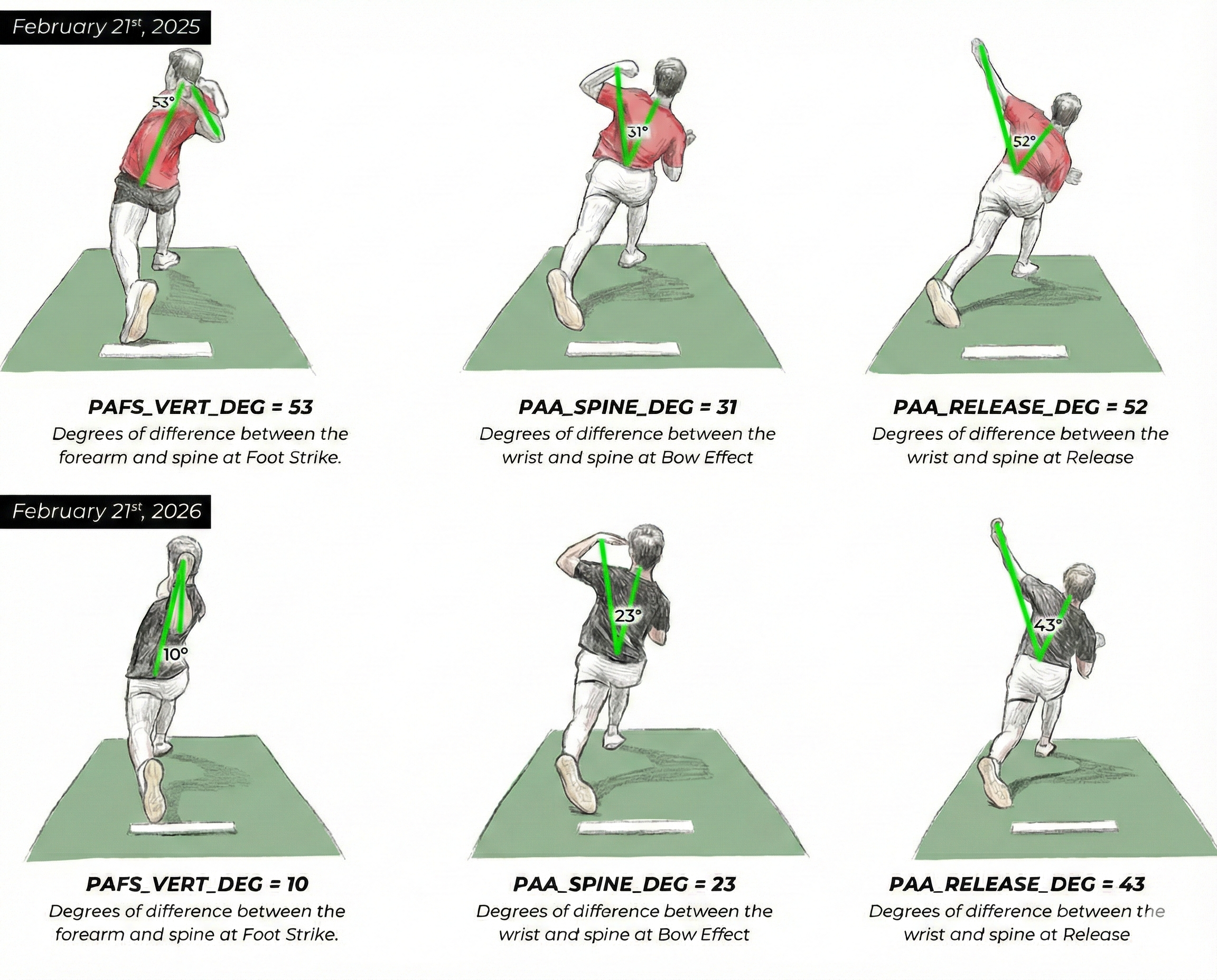
Bohdan’s Year-over-Year Improvement Results
The conversation started the right way, understanding his goals, defining what success looked like, evaluating his current movement patterns, outlining the first steps that would get his arm on time, and reduce variability at release.
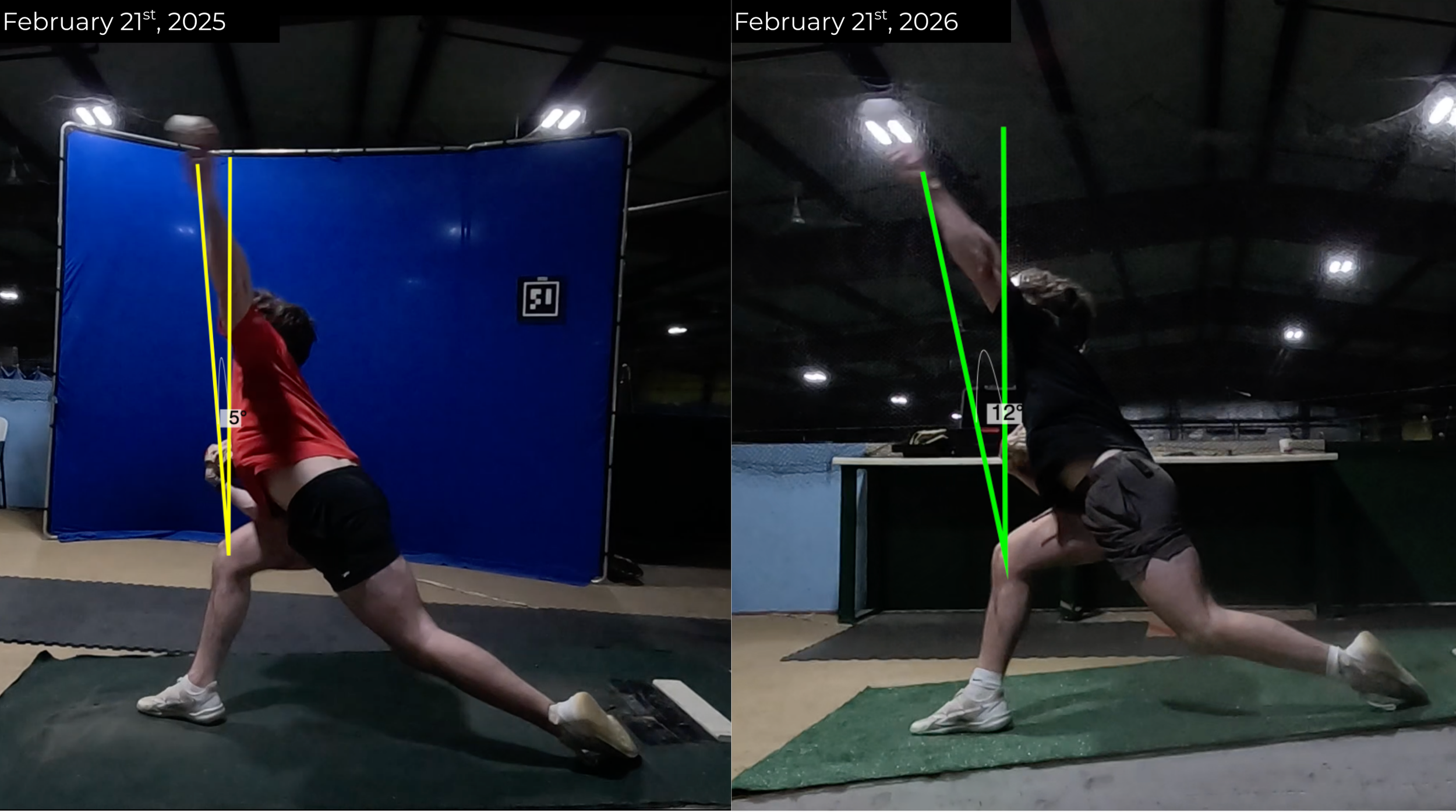
Bohdan Release Extension comparison
With better sequencing and timing, the velocity came. With better sequencing, timing, and velocity came opportunity. What comes next, we don’t know yet, but the foundation is real, stay on time, all the time.
Want help understanding your delivery?
If you want help interpreting your mechanics, improving your command, and building a plan you can follow with clarity, we’re happy to help.
Send us a message to learn more, or sign up for one of our online M.V.P. Programs to get started.