The Pitches Never Thrown
What 12 Years of MLB Injury Data Reveal About Pitcher Health, Availability, and the Cost of Development
Baseball has never known more about the flight of a pitched baseball.
We can measure its velocity, spin, movement, and release characteristics with remarkable precision. We can examine the pitcher's delivery, evaluate his mechanics, and identify performance characteristics that previous generations could scarcely have imagined.
Yet for all we have learned about the pitches thrown, one question receives far less attention.
What about the pitches never thrown?
The missed start. The season interrupted. The career shortened.
These are not merely unfortunate interruptions to performance. They are part of the larger story of how pitchers are developed, how their bodies respond, and whether their performance can be sustained.
Over the past 12 seasons, that story has become increasingly difficult to ignore.
THE COST OF LOST AVAILABILITY
From 2015 through 2026, Major League Baseball pitchers accounted for approximately $5.41 billion in injury-related salary exposure, according to DVS Baseball's analysis of MLB injured-list records.
More than half—$2.79 billion—was associated with shoulder and elbow injuries.
During that period, pitchers accounted for approximately 68% of all MLB injured-list days.
Perhaps more concerning is the direction of the trend.
In 2015, MLB pitchers accumulated 10,392 shoulder- and elbow-related injured-list days. By 2026, that number had reached 20,515.
An increase of 97%.
Elbow-related IL days rose from 6,512 to 14,372 over the same period.
An increase of 121%.
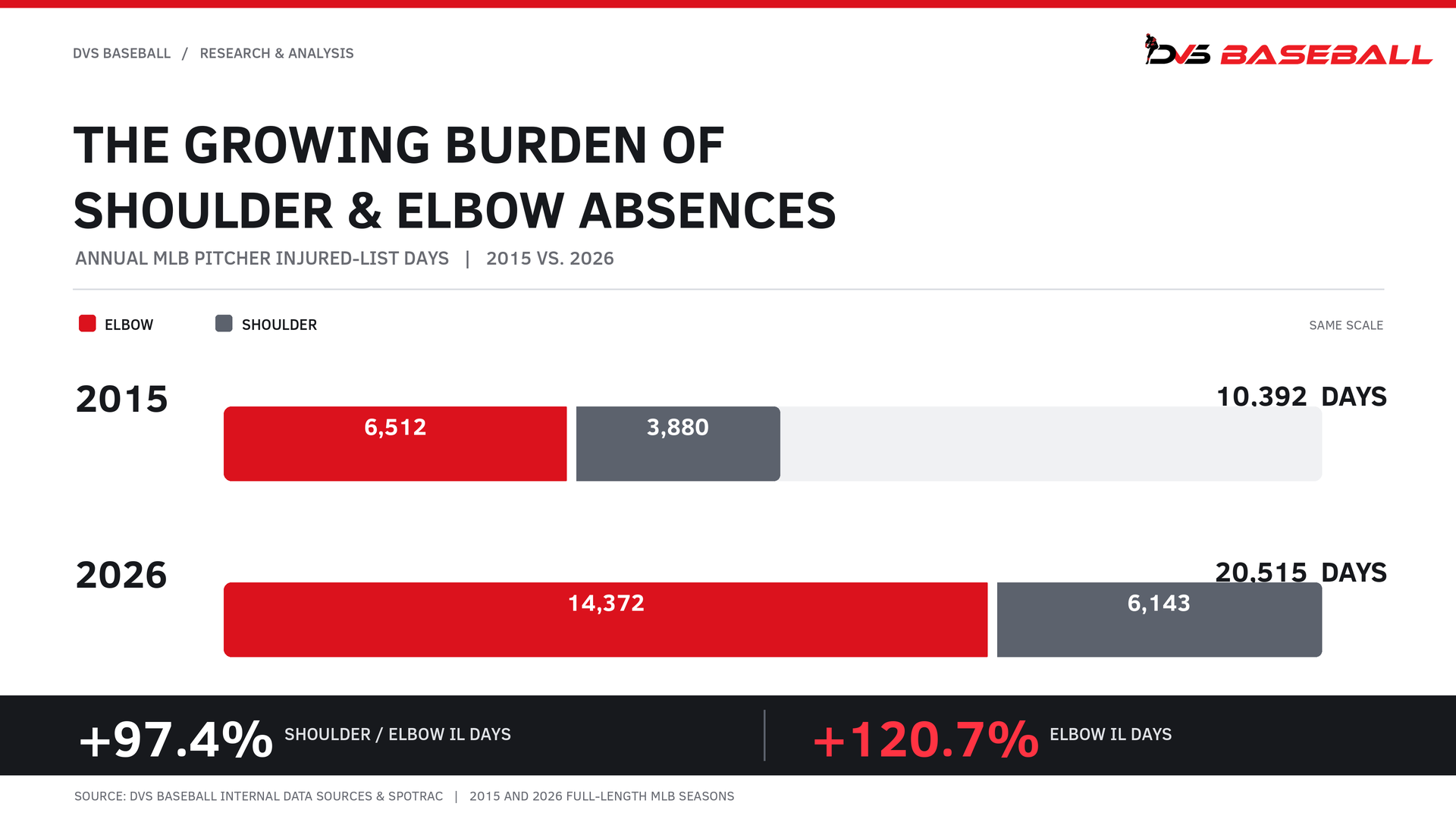
In fact, elbow-related absences accounted for nearly 78% of the overall increase in shoulder and elbow IL days between those two seasons.
These figures represent estimated salary exposure and recorded periods of player unavailability, not necessarily preventable injuries or financial losses.
But even with those distinctions, the central finding is difficult to overlook.
The number of days pitchers have been unavailable because of shoulder and elbow conditions has grown substantially.
And this has occurred during an era of unprecedented investment in pitching performance and development.
THE DIFFERENCE BETWEEN PERFORMANCE AND DEVELOPMENT
There is nothing wrong with pursuing greater velocity. Nor is there anything wrong with measuring spin, movement, biomechanics, or any other characteristic that helps us understand pitching performance. These are valuable tools.
But a tool for measuring performance is not necessarily a method for developing it. And developing performance is not quite the same as developing the ability to sustain it.
Consider a pitcher who increases his fastball velocity from 92 to 97 miles per hour. By one measure, he has improved considerably. But what if his physical capacity has not developed sufficiently to withstand the demands of repeatedly producing that velocity?
What happens when the demands of a single outing become those of an entire season?
An improvement that cannot be sustained is an incomplete measure of development.
The question is not simply what a pitcher can produce. It is what he can sustain.
Since approximately 2011, baseball's development culture has increasingly emphasized measurable performance characteristics, particularly velocity and other pitch qualities. At DVS Baseball, we believe that culture deserves careful examination.
The injury data does not establish that any particular training method caused these trends. Injuries are complex, and many factors influence player health and availability. But the findings do challenge an important assumption: that greater sophistication in measuring performance necessarily produces better long-term development outcomes.
Knowing more about a pitch does not automatically mean we know more about preparing the person who throws it.
MORE IS NOT ALWAYS DEVELOPMENT
Development is often mistaken for addition. More throwing. More strength. More velocity. More intensity. More work.
Yet the purpose of training is not simply to discover how much work an athlete can tolerate. It is to understand what sustainable performance requires and build toward it. That distinction matters because pitchers are not identical.
“Knowing more about a pitch does not automatically mean we know more about preparing the person who throws it.”
They differ in their physical capacities, movement patterns, mechanics, workloads, recovery needs, and competitive demands.
The same training stimulus may prepare one pitcher for greater performance while exceeding another pitcher's current capacity. True development therefore requires more than applying a predetermined workload or pursuing a particular performance metric.
It requires understanding the individual athlete and progressively preparing him for the demands he will face. This does not mean asking less of pitchers. It means developing pitchers who are capable of more.
Not merely for a single pitch, bullpen session, or game, but throughout the demands of a season and, ultimately, a career.
AVAILABILITY IS PART OF PERFORMANCE
Baseball has many ways to measure a pitcher's progress.
Velocity, command, movement, strikeouts, and competitive results all tell us something valuable.
But they do not tell us everything.
A pitcher must be available to use the abilities he has developed.
This does not mean injuries can always be prevented. No training system can eliminate the risks associated with competitive pitching.
It does mean that availability deserves a more important place in how we define successful development.
Availability should not simply be an outcome we report after the fact. It should be one of the measures by which we evaluate whether development is succeeding.
At DVS Baseball, this principle is central to our philosophy.
Development should begin with understanding the athlete, identifying what limits his performance, and establishing the physical and mechanical foundations necessary to improve.
Training, throwing workloads, recovery, and competition should work together toward the same objective.
The goal is not simply to achieve greater performance.
It is to build the capacity to sustain it.
THE PITCHES NEVER THROWN
The past 12 seasons have given baseball an extraordinary amount of information.
They have also left us with a substantial record of lost availability.
Billions of dollars in estimated salary exposure. Hundreds of thousands of injured-list days. And a pronounced increase in elbow-related absences.
The numbers do not provide a single explanation or an easy solution.
But they leave us with a question worth asking.
What good is developing greater performance if we fail to develop the capacity to sustain it?
Baseball will continue to measure the pitches thrown.
It should.
But perhaps the true measure of pitching development is not simply what an athlete becomes capable of doing.
It is what he remains capable of doing.