To the Next Generation of Pitchers: What I Wish I Had Understood at 20.
The Difference Between Success and Understanding
At 20 years old, I was pitching at Virginia Commonwealth University. My numbers were consistent, my execution was consistent, and I knew how to compete. I would eventually become a first-round draft pick of the Los Angeles Dodgers. By nearly every measure, what I was doing worked. And when something works, particularly at a young age, we seldom think to question it.
But that delivery had a shelf life.
A few years later, my professional career was interrupted by major shoulder surgery. The success I had experienced didn't prevent me from confronting questions about my throwing motion that I had never seriously considered.
Today, at 43 years old, my delivery looks entirely different. The task remains the same, but my understanding of that task has fundamentally changed.
At 20, I understood the result I was trying to produce. Today, I understand far more about the principles that make the result possible: sequencing, true rotation, the generation and transfer of energy, and the remarkable way the human body organizes itself to throw a baseball.
There is a considerable difference between being able to do something well and understanding why it works.
I learned that difference much later than I would have liked.
Studying the Movement, Not Just the Pitcher
When my playing career ended in 2011, I began what would become a much deeper education in the skill of throwing a baseball.
Over the next five years, I spent countless hours studying the deliveries of some of the greatest pitchers throughout baseball history. Different generations, different physiques, and different styles, yet similarities in the fundamental principles governing their movement.
My interest wasn't simply in observing how these pitchers moved. It was in understanding why they moved as they did, how their bodies generated and transferred energy, and what characteristics might help explain their ability to sustain performance.
Between 2011 and 2015, this pursuit led to the development of the Delivery Value System, an effort to take what I was learning about sequencing, rotation, and energy transfer and turn it into a measurable approach to understanding the pitching delivery.
In 2015, DVS Baseball rented historic Durham Athletic Park, the former home of the Durham Bulls, to demonstrate the characteristics of an "Old School Windup." The objective wasn't simply to recreate a delivery from another generation, but to illustrate how the organization of body mass, leverage, and rotational sequencing could influence the generation and transfer of energy into a baseball.
UNDERSTANDING THE MOVEMENT. Filmed at historic Durham Athletic Park in 2015, this DVS Baseball demonstration explores the principles behind an Old School Windup, illustrating how body mass, leverage, and rotational sequencing can contribute to the throwing motion. The lesson isn't about returning to an old style, but understanding the physics that make movement effective.
Since 2016, I've had the opportunity to apply and refine this methodology with pitchers at every level of baseball. What began as an effort to understand my own delivery has become an ongoing education through the development of others.
Along the way, I continued applying these principles to my own throwing. At 35 years old, I could throw harder than I had at 25.
To me, that represented something far more important than velocity. I had not become younger, nor had I been given a new arm. What had changed was my understanding of how to use the one I had.
Through those years of observation, investigation, and application, one lesson has remained particularly important: our physical abilities matter enormously, but so does our understanding of how to use them.
As I studied the deliveries of accomplished pitchers, particularly those who sustained performance over time, I began recognizing similarities beneath their very different appearances. I wanted to understand whether these characteristics could be measured rather than simply observed.
That pursuit helped establish the Delivery Value System (DVS) Score, a method of quantifying movement characteristics and investigating their relationship to throwing-arm injury risk.
FROM OBSERVATION TO MEASUREMENT. The DVS Score was developed to quantify fundamental movements of the pitching delivery. This distribution shows how professional pitchers scored across the 24-point model, providing a measurable framework for evaluating movement patterns linked to throwing-arm injury risk.
What began as an effort to understand why great pitchers moved the way they did eventually became a means of evaluating how other pitchers move and where opportunities for improvement might exist.
Copying a movement is not the same as understanding its purpose.
And understanding its purpose is what allows us to improve it.
Individuality Doesn't Change the Laws of Physics
One of the most common statements in baseball is that there is no one way to throw a baseball.
I agree.
Pitchers differ in height, strength, anatomy, mobility, and physical ability. Their deliveries will naturally look different, just as no two people walk, run, or move precisely alike.
But individuality in appearance does not eliminate the fundamental principles of movement.
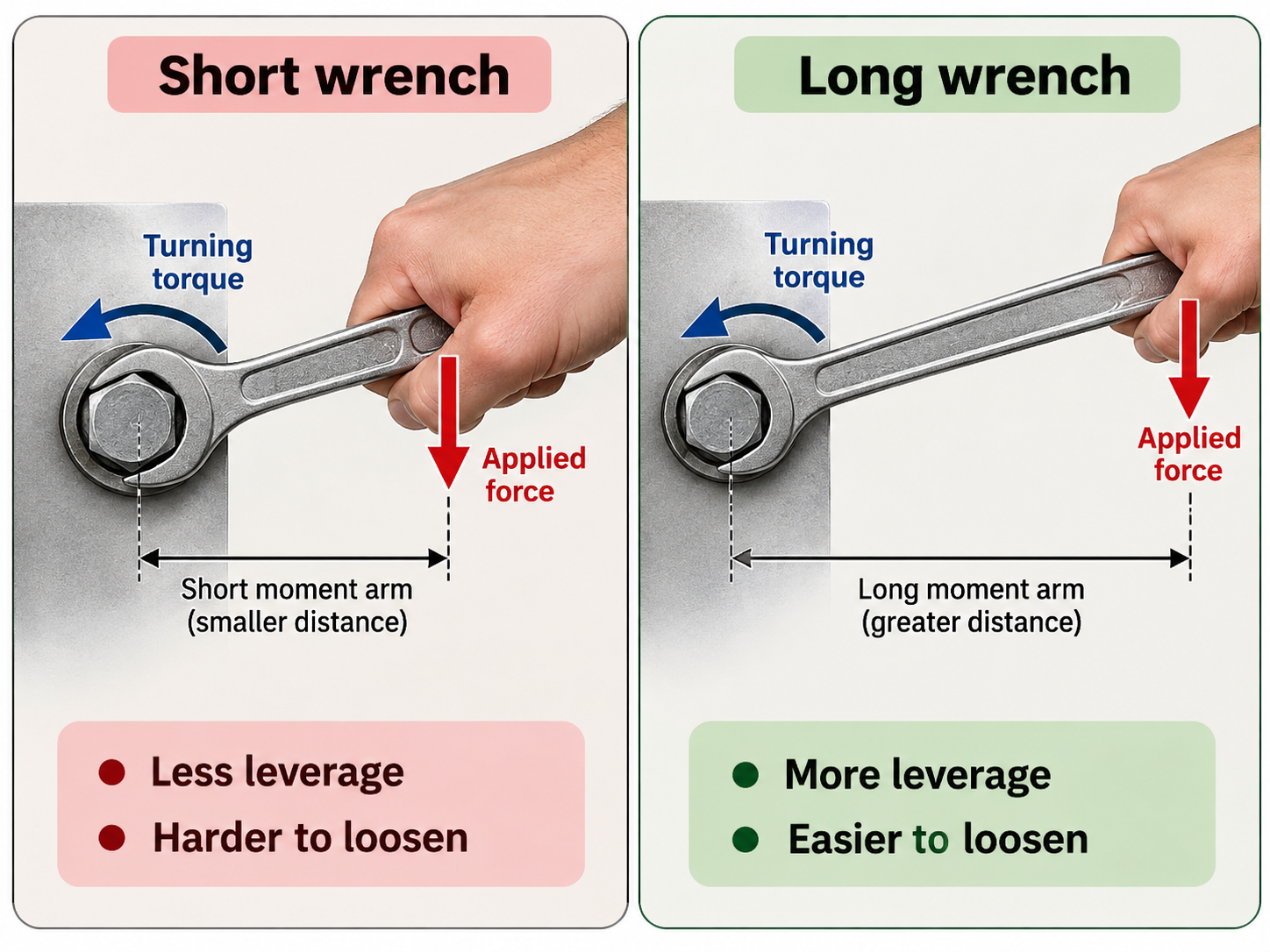
LEVERAGE. The same amount of force can produce a different rotational effect depending on where and how it is applied.
The laws of physics do not change from one pitcher to another. Neither does the importance of sequencing, rotation, leverage, and the effective transfer of energy.
Consider a few simple examples from everyday life.
Why does a longer wrench make it easier to loosen a stubborn bolt? Because increasing the distance from the rotational axis allows the same force to produce greater torque. We haven't necessarily become stronger. We've simply found a more effective way to apply our strength.
Now consider a child on a playground swing. A relatively small push, applied at the right moment, can send the swing higher. But apply that same force at the wrong time, and we may accomplish very little or even slow the swing down. The force matters, but so does the timing.
Or consider something as simple as an elastic resistance band.
In this demonstration, I stretch two AC Bands away from a fixed point on a pole, pulling one considerably farther than the other. When released simultaneously, the band with the greater stretch reaches the fence first, despite having farther to travel.
THE PHYSICS OF STORED ENERGY. Two AC Bands are stretched different distances and released simultaneously. In this demonstration, the band stretched farther reaches the fence first. Greater stretch stores more elastic potential energy, illustrating how the conditions established before movement influence what happens after release.
We understand these principles in everyday life, often without giving them much thought. Leverage changes how force produces rotation. Timing influences how effectively force contributes to movement. And the way energy is developed, stored, and transferred influences the result.
These same principles help us understand the pitching delivery. What appears to be one continuous motion is actually a coordinated sequence of movements, each contributing to the task. At DVS Baseball, we examine the delivery through four interconnected phases: Acceleration Phase 1, Transfer, Acceleration Phase 2, and Deceleration. Each serves a different mechanical purpose, from organizing movement and developing energy to transferring that energy into the baseball and managing the forces that follow.
FROM PHYSICS TO PITCHING. The DVS Delivery Phases illustrate how coordinated movement, sequencing, rotation, and energy transfer contribute to the pitching delivery. Although individual styles may differ, every pitcher must organize and control the forces involved in accelerating and releasing a baseball.
The human body is considerably more complex than a wrench, playground swing, or elastic band. The examples aren't instructions to maximize leverage or stretch in a pitching delivery. They illustrate physical principles that must be understood in the context of the entire movement.
Every pitcher is attempting to solve the same fundamental problem: organize the body to generate and transfer energy through a coordinated sequence of movement, accelerate the baseball, and manage the forces that follow.
How each pitcher solves that problem will differ. But understanding the principles involved allows us to investigate whether a more effective solution may exist.
We often mistake the freedom to move differently for the absence of principles that guide effective movement.
The two are not the same.
There may be countless ways to accomplish a task. That does not mean every solution is equally effective.
And understanding the difference is one of the great opportunities we can offer the next generation of pitchers.
Are Movement Preferences Always the Best Solutions?
There is growing interest throughout player development in identifying an athlete's natural movement preferences.
Understanding how an athlete prefers to move certainly has value. But I believe an equally important question is often overlooked: how did that preference develop?
From an early age, a pitcher's movement is influenced by countless factors. Physical growth, strength, mobility, coaching instruction, training environments, previous injuries, and the demands placed upon the athlete all contribute to how a movement pattern develops.
Some tendencies may reflect individual anatomy or coordination. Others may be adaptations to years of instruction or physical limitations.
Over time, these movements become familiar. They may even become remarkably consistent.
But familiarity does not necessarily establish efficiency.
A pitcher can become exceptionally skilled at repeating a movement pattern without ever understanding whether there is a better way to accomplish the same task.
MOVEMENT CAN CHANGE. A comparison of pitching positions from 2010 and 2020 illustrates how the organization of the body and throwing arm can differ. Understanding these differences helps us investigate the relationship between movement patterns, sequencing, and performance.
This doesn't mean we should disregard individuality or attempt to force every athlete into the same mechanical model. Quite the opposite.
Sometimes the most important thing we can give a young athlete isn't another instruction, but a better understanding of the movement he's already trying to perform.
The Problem With Using Velocity as Proof
Today, we routinely see videos explaining how the latest pitching prospect throws 95, 98, or 100 mph.
A remarkable athlete produces a remarkable result, and almost immediately certain characteristics of his delivery become instructional examples for others.
There is certainly value in studying exceptional athletes. I've devoted much of my career to doing exactly that. But we should be careful about the conclusions we draw.
A pitcher throwing 100 mph has demonstrated an extraordinary ability to accelerate a baseball. That accomplishment deserves recognition.
It does not, however, establish that the movement responsible for producing that velocity is mechanically optimal, or that the physical demands associated with it can be sustained over time.
The radar gun measures the result. It does not explain the entire process.
And the process matters.
Two pitchers can produce similar velocities while organizing their bodies differently, transferring energy through different movement patterns, and experiencing different mechanical demands.
Success is evidence that an athlete has found a solution. It is not proof that he has found the best possible solution.
We should study great pitchers not simply to reproduce their movements, but to better understand the principles behind their success and determine how those lessons might benefit another individual.
Perhaps the more meaningful question isn't simply how a pitcher throws 100 mph.
It's how he can continue to perform at a high level, execute consistently, and remain available to compete throughout his career.
Turning Understanding Into Player Development
This philosophy has shaped DVS Baseball's development.
Our objective has never been to make every pitcher look alike. It has been to understand how pitchers move, identify meaningful differences in their sequencing, and use that information to guide development.
In 2018, our research on the Delivery Value System was published in Orthopedics. The study evaluated 449 professional pitchers and identified significant associations between components of their delivery mechanics and injury risk.
The findings were not a promise that any particular delivery could prevent injury. They demonstrated the value of evaluating movement through measurable characteristics rather than relying solely on appearance or opinion.
Today, through DVS X-Ray and our development methodology, we continue applying that approach. We evaluate the delivery, consider the physical characteristics of the athlete, identify opportunities for improvement, and measure how those changes translate into performance.
Because the purpose of biomechanics isn't simply to collect information.
It's to make that information useful.
A pitcher should be able to understand what he is doing, why he is doing it, and whether a better solution may exist.
That is why we developed the DVS Score, a measurable assessment of a pitcher's delivery, and the M.V.P. Program, which helps turn assessment findings into an individualized development process.
The assessment provides a starting point. The training provides an opportunity to improve.
Understanding How to Throw Is Only the Beginning
A pitcher's development doesn't end with understanding the delivery. That knowledge must also be applied through training, workload, recovery, and competition.
Even a well-organized delivery must be prepared to meet the physical demands of the game.
A pitcher who has thrown 70 pitches in competition faces a different problem the following day than a pitcher who has spent the week building throwing capacity. The demands change, and the training must respond.
This is another lesson I've learned through years of working with pitchers: development cannot be separated from the circumstances in which an athlete is expected to perform.
It's one reason we developed Wavelength, our adaptive throwing program.
FROM UNDERSTANDING TO APPLICATION. Wavelength brings DVS Baseball's development philosophy into an adaptive throwing program. Through daily readiness assessments, individualized throwing recommendations from Coach DaViS, and post-session workload tracking, pitchers receive guidance that responds to their recovery, competition schedule, and goals.
Wavelength applies individualized throwing distances, intensities, workload, recovery, and competition timing to help pitchers understand what to do each day and why.
The objective is not merely to throw more, farther, or harder. It is to make each throwing session serve a purpose in the athlete's larger development.
Just as understanding movement can help us make better decisions about how we throw, understanding workload and recovery can help us make better decisions about when and how much we throw.
A Message to the Next Generation
To the young pitcher who has already achieved success, my encouragement is simple: remain a student of the skill.
Be proud of those accomplishments. They represent years of work, sacrifice, and dedication.
But don't allow what you can accomplish today to become the boundary of what you're willing to understand tomorrow.
Ask questions. Study the greatest pitchers who came before you. Learn how your body moves, how energy is transferred, and how the principles of physics apply to the task you're trying to accomplish.
You don't need to abandon your individuality to improve. Nor should you change simply because someone believes your delivery ought to look different.
But you should be willing to understand your movement well enough to recognize when a better solution is possible.
I share these experiences not because I believe I've discovered everything there is to know about throwing. Quite the opposite. The more I've learned, the more I've come to appreciate how much remains to be understood.
But I also know how valuable that understanding can be, and how much I would have benefited from receiving it earlier in my career.
At 20, I knew how to succeed with the delivery I possessed. At 43, I understand far more about the delivery I can develop.
My hope is that sharing what I've learned may help another pitcher discover these things sooner.
There are many ways to throw a baseball. But that doesn't mean every way is equally effective.
And perhaps the greatest opportunity for a talented young pitcher isn't discovering how much harder he can throw, but understanding how much more he has yet to learn.